I Explored Civoryx Global Fraud Index for a Month — Here’s How Useful Its Scam Score Data Really Is
For fraud analysts, compliance officers, and risk managers, the landscape of cybercrime often feels like a relentless game of whack-a-mole. By the time a new phishing template or payment scam is formally documented in an industry threat report, the malicious actors behind it have already pivoted to a new narrative, a new delivery channel, and a new target demographic. Traditional threat intelligence often tells us what happened yesterday. What we desperately need is a tool that tells us what is happening right now.
Enter the Civoryx Global Fraud Index!
Marketed as a real-time barometer of public attention regarding scams and fraud, Civoryx attempts to map the digital anxieties of the global populace. By aggregating and analyzing search queries, it promises to give risk professionals a leading indicator of where fraud vectors are actively concentrating. Intrigued by the premise, and slightly skeptical of the execution, I decided to integrate the platform into my daily threat intelligence workflow for an entire month.
I wanted to know: Is this just glorified keyword tracking, or does it actually provide actionable intelligence for a modern compliance team? Here is an exhaustive look at what I found during my month-long deep dive into the February 2026 data, and how useful its Scam Score data genuinely is.
The Core Philosophy: Tracking Attention over Incident
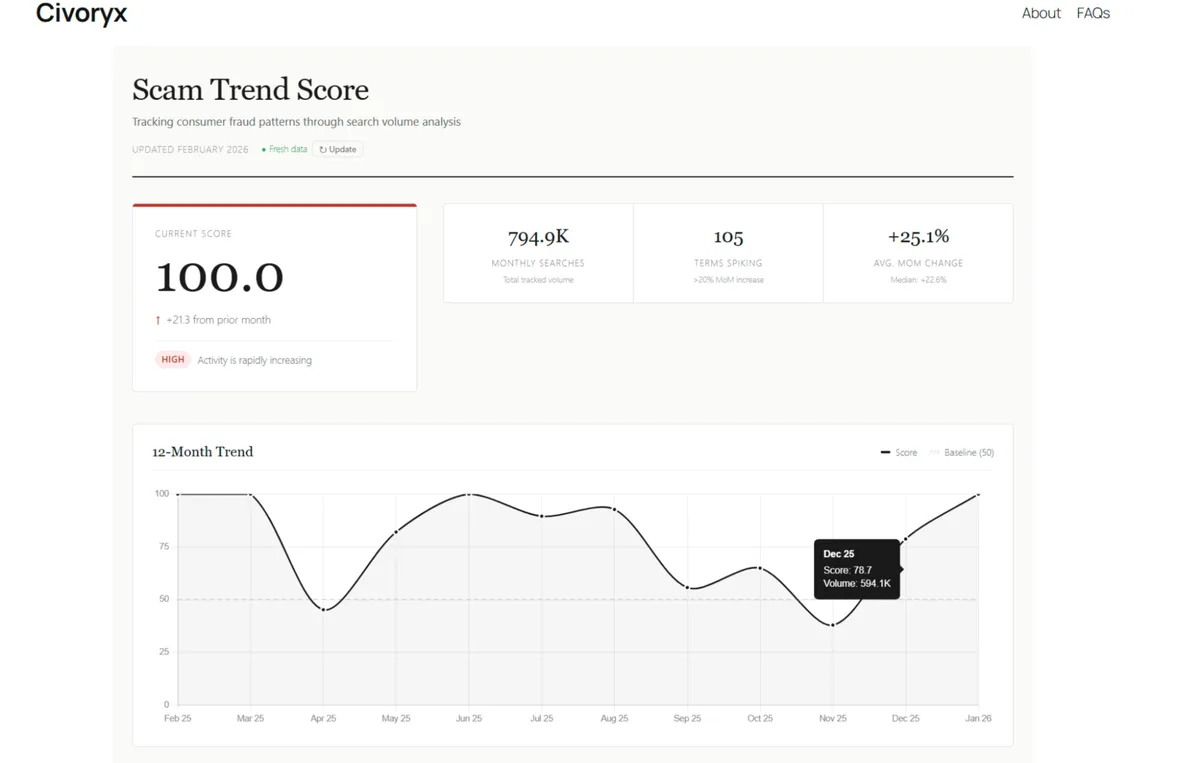
Before diving into the numbers, it is crucial to understand what Civoryx is actually measuring. The platform does not directly measure the volume of successfully executed frauds, nor does it track the financial losses associated with them. Instead, the Civoryx Global Fraud Index measures attention momentum.
When a consumer receives a suspicious SMS claiming their toll payment is overdue, their immediate reaction is often to copy the text and paste it into a search engine, or type a query like “ez pass text message real.” Civoryx captures this aggregate anxiety. It operates on the principle that sudden spikes in specific, scam-related search queries correlate directly with massive, active distribution campaigns by threat actors.
The Secret Sauce: TrendWeight™
One of my initial reservations about a search-based index was the potential for data skew. If a localized news station in a major metropolitan area runs a high-profile story about a specific scam, could the resulting panic-searching falsely inflate the global threat score?
This is where the platform’s underlying architecture becomes interesting.
Civoryx employs a proprietary weighting system called TrendWeight™ that adjusts for regional search bias. This algorithmic layer actively analyzes the geographic distribution and context of the queries. If a massive spike in searches for “bank impersonation scam” is strictly localized to one province or state following a local broadcast, TrendWeight™ dampens its impact on the Global Fraud Index. Conversely, if a highly specific query like a unique “coinbase text scam” phrase begins blooming simultaneously across multiple disparate global regions, the system amplifies the score, recognizing it as a coordinated, widespread campaign. This unique claim to bias adjustment is arguably the platform’s most valuable technical asset.
What the February 2026 Data Reveals: The Anatomy of a Threat Landscape
Logging into the Civoryx dashboard throughout February provided a fascinating, and somewhat alarming, view into the mechanics of seasonal and narrative-driven fraud.
Analysis of the latest keyword dataset highlights a highly concentrated signal. The movement of the index was not driven by a broad, general increase in cybercrime awareness, but rather by a very specific, small cluster of themes that were dominating the public’s search behavior.
Top Contributors to the Scam Score
To understand what was driving the index, we have to look at the weighted impact of individual themes. The platform assigns a numerical contribution score to each category, indicating how much that specific vector is pulling the overall global index upward.
Here are the top contributors for February 2026:
| Fraud/Scam Theme | Weighted Contribution Score |
| Tax fraud | 75.74 |
| EZ Pass scams | 57.94 |
| Credit card fraud | 21.36 |
| Coinbase text scam | 12.43 |
| PayPal scam email | 10.53 |
| Toll scam text | 9.51 |
| Geek Squad scam | 7.83 |
| DMV scam text | 5.20 |
| Visa fraud | 3.57 |
| PayPal email scam | 2.20 |
Looking at this data from a compliance perspective, the concentration is incredibly revealing. It indicates that seasonal financial fraud and highly specific impersonation campaigns are currently exerting the strongest influence on global fraud attention.
The absolute dominance of tax fraud (contributing a massive 75.74 to the index) aligns perfectly with the seasonal reality of late winter and early spring. As citizens begin preparing their financial documents, threat actors ramp up their IRS, HMRC, or local tax authority impersonation campaigns. However, it is the secondary tier of contributors that reveals the most actionable intelligence.
The Channel Shift: Fastest-Growing Scam Themes
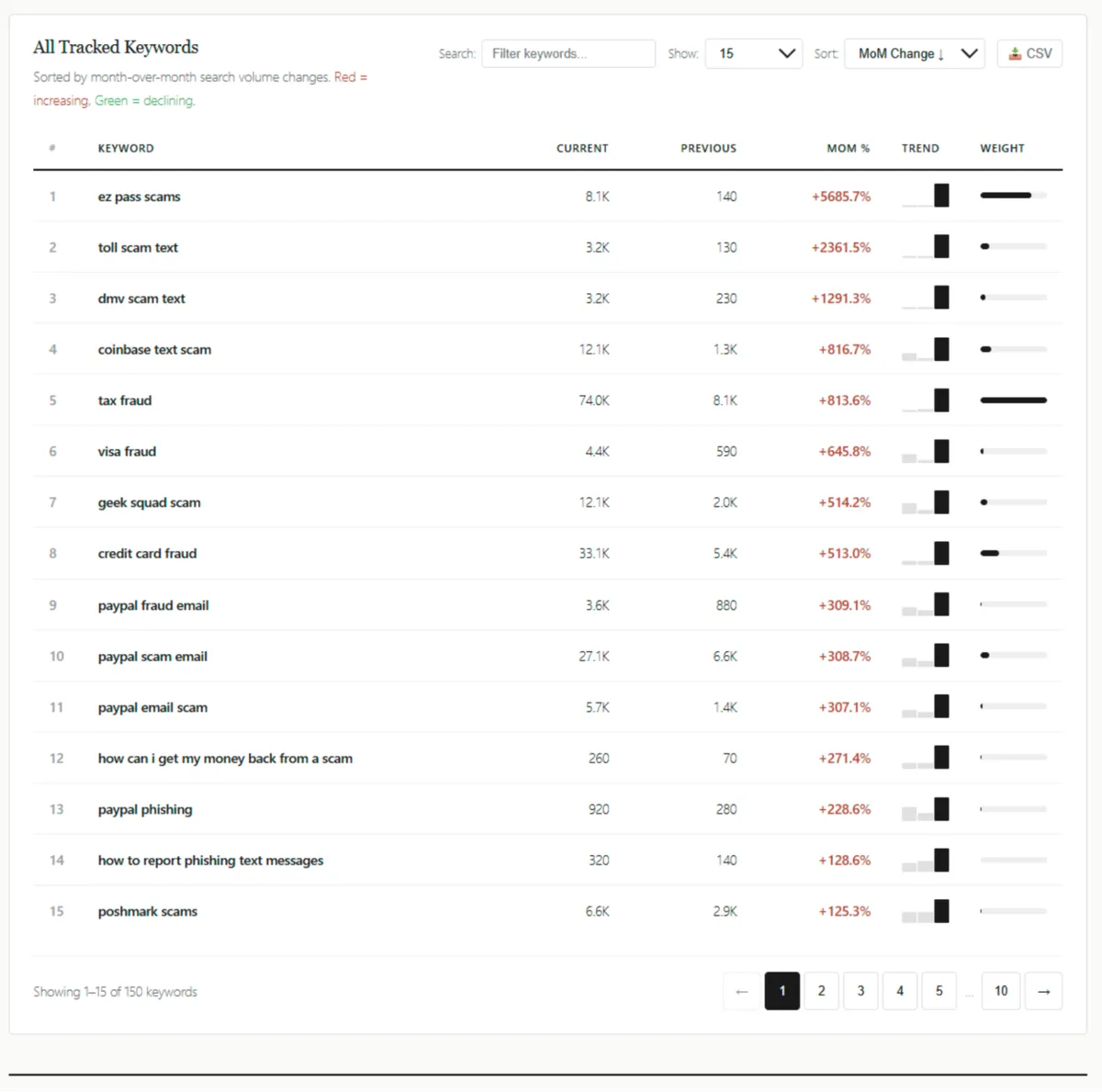
While the top contributors show us the sheer volume of attention, the growth rates show us the velocity of new threat actor tactics. The Civoryx dataset for February reveals unusually sharp month-over-month growth in several infrastructure and payment-related scams.
The fastest-growing categories highlight a distinct tactical pivot:
- EZ Pass scams: +5,685%
- Toll scam text: +2,361%
- DMV scam text: +1,291%
- Coinbase text scam: +817%
- Tax fraud: +814%
- Visa fraud: +646%
- Geek Squad scam: +514%
- Credit card fraud: +513%
What does a staggering +5,685% increase in “EZ Pass scams” searches actually mean? It means a botnet or a coordinated group of threat actors likely acquired a massive database of phone numbers and blasted out millions of SMS messages claiming users had unpaid toll violations.
Together, these specific spikes point to a very clear channel shift toward SMS-driven impersonation (Smishing) and immediate payment fraud. The bad actors are relying less on complex, long-con email chains and more on the immediate panic induced by a text message demanding payment for a seemingly routine infrastructure service (tolls, DMV).
For a compliance or fraud strategy team, this pattern is gold. It is the exact type of data needed to reassess customer-communication controls and dynamically adjust alerting thresholds. If you know SMS toll scams are spiking by over 5,000%, your customer support teams can be pre-briefed, and your transaction monitoring systems can be tuned to look for rapid, small-dollar transactions that match the profile of these fake toll portals.
The Falling Tides: Declining Attention in February
One of the most insightful aspects of tracking data over a month is seeing what the public is ignoring. The Civoryx dashboard clearly showed that not all categories were rising. In fact, searches for broader, older, or more generic queries fell significantly:
- Is this a scam: -55%
- Gift card scam: -46%
- McAfee scam: -45%
- Brushing scam: -19%
- Phishing: -18%
This divergence is fascinating. Specific scam types (like the EZ Pass texts) are rising vertically, while generic awareness queries (like “is this a scam” or “phishing”) are falling dramatically.
In the fraud intelligence community, this often signals a narrative-driven fraud cycle. When threat actors deploy a highly specific, highly convincing narrative (like a localized toll charge), the victim doesn’t search for a generic “is this a scam.” They search for the specific text of the message they received. The threat dominates public attention so thoroughly that the broader, educational searches fall by the wayside. The public isn’t researching fraud concepts; they are reacting to immediate, specific digital threats.
Category Structure: Deconstructing the Signal
To make the data actionable, Civoryx allows users to group these individual keywords by intent, showing exactly how the index composition breaks down across broader risk categories. Reviewing the February profile, the structure looks like this:
- Tax-related fraud: The single largest driver, making up approximately 75.7 of the index contribution. This is the seasonal behemoth.
- Payments & financial scams: Contributing roughly 56 across various credit card, Visa, and digital wallet (PayPal/Coinbase) fraud vectors.
- Messaging vectors (SMS/email/calls): Contributing roughly 15.6. This reflects the delivery-channel risk, highlighting the surge in Smishing mentioned earlier.
- Phishing (generic): Hovering at a low contribution of about 4, remaining relatively stable but dwarfed by specific narratives.
- Reporting/prevention queries: Contributing a mere 1.7, showing lower growth and indicating that public focus is currently reactive rather than proactive.
This breakdown is incredibly useful for departmental resource allocation. If your fraud team has a limited budget for consumer education in Q1, the data makes it blatantly obvious that generic “how to spot a phish” campaigns will likely fall flat, while targeted warnings about SMS toll scams and tax impersonators will meet the consumer exactly where their current anxieties lie.
Real-World Utility: How Compliance Teams Can Use Civoryx
After a month of living inside this data, the primary question remains: is it useful? The answer is a resounding yes, provided you understand its place in your technology stack.
The February profile underscores the score’s main strength: rapid visibility into where fraud attention is concentrating right now. For risk and compliance functions, this platform is not a replacement for traditional transaction monitoring, but it is a powerful catalyst for proactive defense. I found the data naturally supported four key operational areas:
- Short-term threat briefings: Security Operations Centers (SOCs) and fraud analysts can use the fastest-growing list to inform daily or weekly stand-ups. If “Coinbase text scam” jumps 800% over the weekend, the team knows exactly what to look for on Monday morning.
- Customer warning campaigns: Marketing and customer success teams can utilize the category structure to draft highly relevant, timely warnings. Instead of a generic quarterly newsletter about password hygiene, a bank can send a push notification specifically warning users about the DMV text scam that is currently spiking in their region.
- Prioritization of transaction monitoring rules: If the index shows a massive surge in a specific type of payment fraud, compliance teams can temporarily tighten the rules and velocity checks around those specific merchant category codes or transaction profiles.
- Context for board-level risk reporting: When explaining fraud losses or budget requests to executive leadership, the Civoryx Scam Score provides quantifiable, third-party data to justify the narrative. It transforms “we feel SMS fraud is getting worse” into “global search attention for SMS toll scams increased by 5,685% this month.”
The Catch: A Context Indicator, Not a Ground Truth
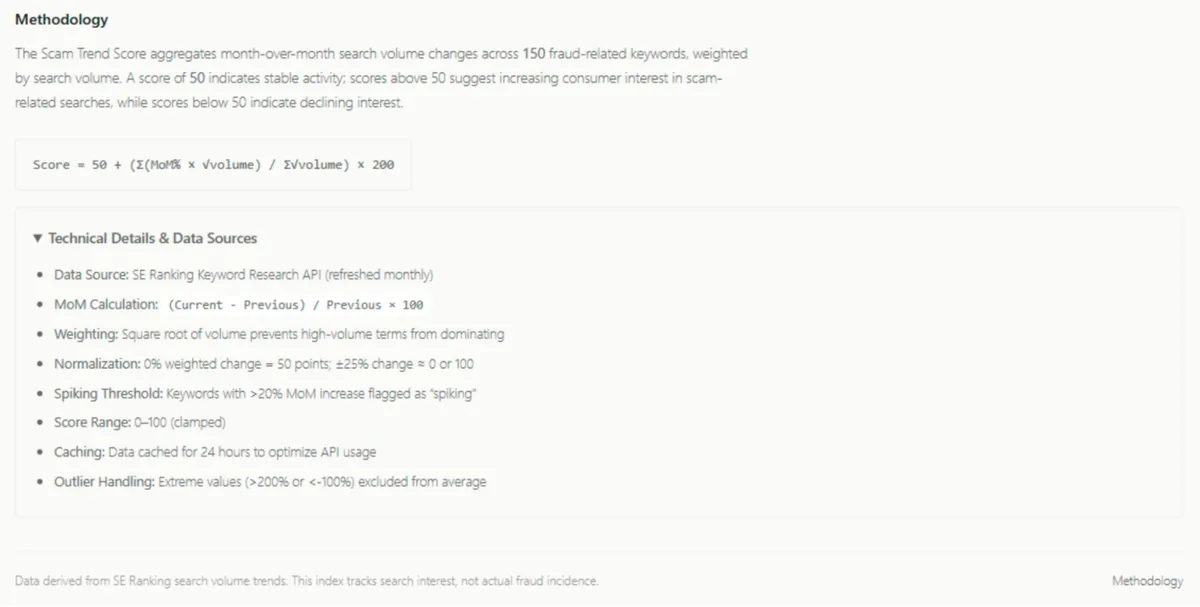
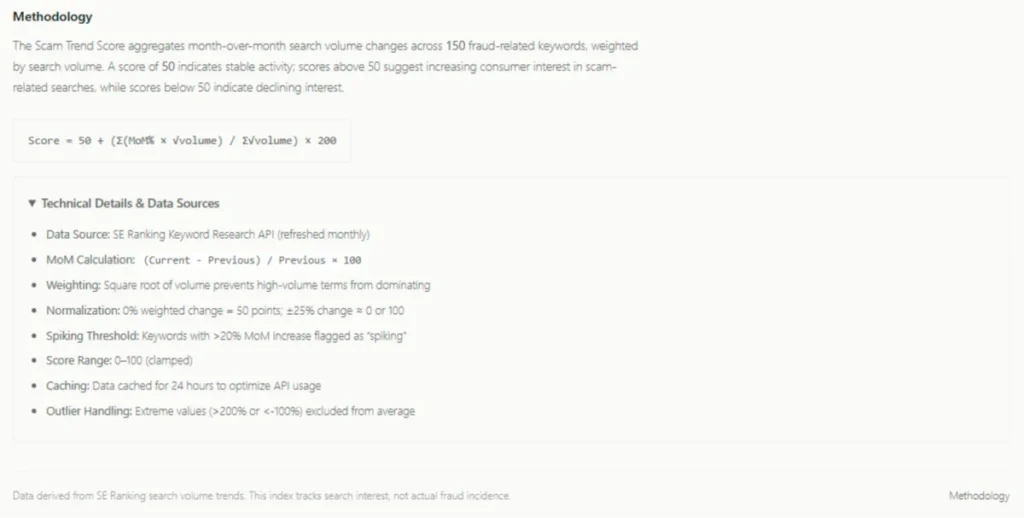
As with any search-based index, the Scam Trend Score has inherent limitations that must be acknowledged.
Civoryx measures attention momentum, not confirmed incident volume or financial loss. It is entirely possible for a highly visible, incredibly spammy SMS campaign to generate a massive spike in the Scam Score without actually successfully defrauding a large number of people. If the scam is obvious, people will search it, but they might not fall for it. Conversely, highly sophisticated, targeted spear-phishing attacks against corporate executives (Business Email Compromise) may result in millions of dollars in losses without ever generating enough public search volume to move the Civoryx needle.
Most mature organizations will therefore need to treat Civoryx as a leading context indicator. It should never exist in a vacuum. The true power of the platform is unlocked when you pair its external search data with your internal case data, regulatory alerts, and actual loss metrics for a complete risk picture.
If Civoryx shows a spike in Visa fraud searches, and your internal monitoring simultaneously shows a 10% uptick in Visa chargebacks, you have validated the threat and can deploy countermeasures with high confidence.
Final Verdict
After 30 days of exploring the Civoryx Global Fraud Index, I am convinced that tracking search intent is a vital layer of modern fraud defense. The platform’s ability to isolate specific, rapidly growing threat vectors—like the 5,000%+ surge in EZ Pass scams—provides the kind of early warning system that traditional, lagging indicators simply cannot match.
The inclusion of the TrendWeight™ system successfully mitigates the noise of localized panics, ensuring the global index remains a reliable macro-indicator. While it requires a disciplined team to interpret the data and pair it with internal metrics, Civoryx provides a unique, real-time pulse on the mechanics of digital deception. It brings us one step closer to predicting the whack-a-mole game, rather than just reacting to it.
FAQ
1. What exactly does the Civoryx Global Fraud Index measure?
The index measures public attention momentum, not confirmed fraud incidents or financial losses. By aggregating global search queries (e.g., “is this ez pass text real”), it gauges real-time consumer anxiety and identifies where malicious actors are currently focusing their distribution campaigns.
2. How does Civoryx prevent local news panic from skewing the global score?
Civoryx uses a proprietary algorithmic layer called TrendWeight™. This system adjusts for regional search bias. If a localized news broadcast causes a spike in searches within a single state, TrendWeight™ dampens its impact on the global score. Conversely, if a specific scam phrase blooms simultaneously across multiple regions, the system amplifies the score.
3. Does a high Scam Trend Score mean our organization is actively losing money to that threat?
Not necessarily. The index is a leading context indicator. A high score means a specific scam is highly visible and actively targeting consumers, but it doesn’t guarantee those consumers are falling for it. It should always be paired with your internal transaction monitoring and loss metrics to confirm actual financial impact.
4. Why are generic searches like “is this a scam” decreasing while the overall index goes up?
This divergence points to a narrative-driven fraud cycle. When threat actors deploy highly convincing, specific narratives (like a fake toll charge), victims don’t search for broad educational terms like “phishing.” Instead, they search the exact text of the message they received, causing specific scam categories to spike while generic queries fall.
5. What is the most significant tactical shift revealed in the recent data?
The February 2026 data highlights a massive channel shift toward SMS-driven impersonation (Smishing) and immediate payment fraud. Scams mimicking infrastructure and routine services saw exponential month-over-month growth, led by EZ Pass text scams (+5,685%) and toll scam texts (+2,361%).
6. Why is tax fraud currently the largest contributor to the index?
Tax fraud has a massive weighted contribution score (75.74) entirely due to seasonality. During late winter and early spring, threat actors heavily ramp up impersonation campaigns targeting taxpayers preparing their documents, making it the dominant driver of public fraud anxiety during this time of year.
7. Is Civoryx meant to replace our existing transaction monitoring tools?
Absolutely not. Civoryx is designed to be an early warning system that complements your existing stack. While internal tools tell you what has already happened within your ecosystem, Civoryx tells you what threats are gaining momentum globally so you can preemptively tune your monitoring rules.
8. How are the search keywords organized within the platform?
Keywords are grouped by intent and risk category to help teams allocate resources effectively. The main categories include Tax-related fraud, Payments & financial scams (like credit card or digital wallet fraud), Messaging vectors (tracking delivery-channel risk like SMS/email), generic phishing, and reporting/prevention queries.
9. How can our customer success and marketing teams use this data?
Marketing and communications teams can use the fastest-growing trend data to draft highly targeted customer warnings. Instead of sending generic quarterly newsletters about password safety, teams can send timely push notifications warning users about the specific DMV or toll text scams currently spiking in their region.
10. How can our SOC and fraud analysts integrate this into their daily workflow?
Security Operations Centers (SOCs) can use the daily or weekly changes in the index for short-term threat briefings. If a specific threat, like a “Coinbase text scam,” jumps hundreds of percentage points over a weekend, analysts know exactly which new narratives to look for when investigating suspicious account activity on Monday morning.