Civoryx vs Sumsub vs Veriff: Awareness Data vs Active Fraud Prevention
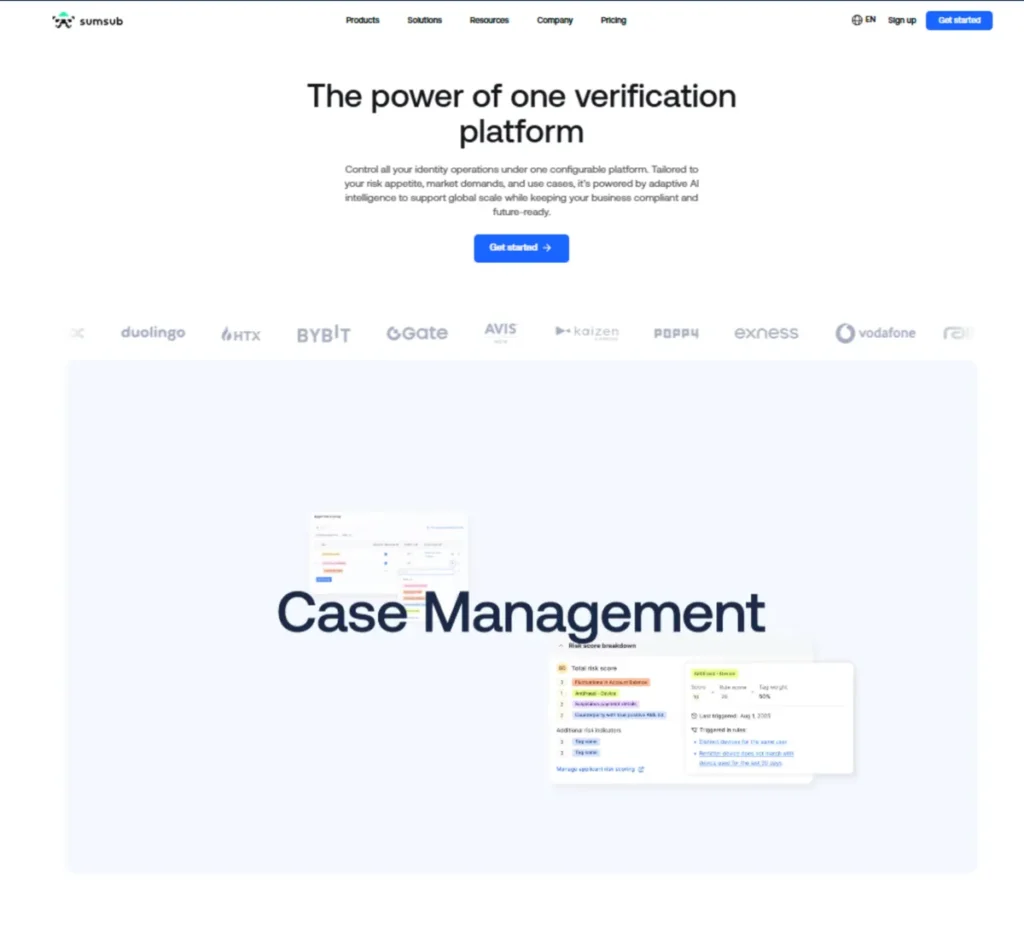
In the rapidly evolving landscape of 2026, the battle against digital fraud has split into two distinct fronts: Active Prevention (stopping the fraud at the door) and Awareness Data (understanding where the threat is coming from before it arrives).
While industry titans like Sumsub and Veriff focus on the technical barriers of identity verification (IDV), a new player, Civoryx, has emerged to provide the “weather report” for fraud trends. This article compares how these three solutions—Sumsub, Veriff, and Civoryx—create a holistic defense strategy by balancing real-time verification with global trend awareness.
Awareness Data vs Active Fraud Prevention: Statistics
In the current 2026 landscape, the “Sophistication Shift” has fundamentally changed the math of fraud. We are no longer seeing high-volume, amateur attempts; we are seeing professionalized, multi-step attacks designed to slip through standard checks. The following statistics illustrate the growing gap between what we think we know (awareness) and what is actually happening at the gate (active prevention).
The Velocity of Modern Fraud
While active prevention tools focus on the “hit rate,” awareness data looks at the “swell.” According to recent 2025-2026 industry reports, the nature of identity crime has moved from content to context:
- Sophistication Spike: Sumsub reports a 180% YoY increase in “sophisticated” fraud—attacks that use multi-step techniques to bypass traditional KYC.
- Impersonation Dominance: Veriff’s data shows that impersonation fraud now accounts for over 85% of all fraudulent attempts.
- The Deepfake Pulse: Biometric fraud is evolving rapidly; deepfake attempts were recently clocked at a rate of one every five minutes.
- Digital Forgery: AI-assisted document forgeries have surged by 244%, making physical counterfeiting almost obsolete in favor of digital-first manipulation.
The cost of missing a trend is often higher than the cost of the fraud itself. By the time a business reacts to a new scam, the financial damage is often already baked into the quarter.
| Metric | Awareness Data Signal (Civoryx Context) | Active Prevention Outcome (Sumsub/Veriff) |
| Total Global Loss | Projected $10.5 Trillion annual cost of cybercrime by 2025. | $5.75 cost to the business for every $1 lost to fraud. |
| Targeted Sectors | Crypto scams estimated at $17 Billion in losses. | E-commerce fraud rates are 18x higher than the global average. |
| Success Efficiency | AI-enabled scams are 4.5x more profitable for attackers. | Multi-step attacks rose from 10% to 28% of total attempts. |
Why “The Gap” Exists
The disconnect between awareness and prevention is measurable. While 75% of risk professionals believe fraud is becoming increasingly AI-driven, nearly 37% of firms still rely on manual processes or isolated checks.
This is where the Civoryx Scam Trend Score becomes a vital statistical layer. By monitoring 150+ keywords and using its TrendWeight™ system to adjust for regional search bias, it identifies statistical anomalies before they translate into the 180% spikes seen by IDV providers.
Statistical Insight: Businesses using awareness data to proactively adjust their Sumsub or Veriff risk thresholds report a significant reduction in the “Sophistication Gap,” allowing them to catch coordinated rings that typically bypass standard pattern recognition.
The Landscape: Awareness vs. Action
In the fraud prevention ecosystem, Sumsub and Veriff act as the sentries. They verify documents, check biometrics, and block suspicious users in real-time. Civoryx, by contrast, acts as the intelligence agency. It doesn’t block individual users; instead, it tracks the macro-shifts in fraud behavior across the internet.
Civoryx: The Global Fraud Index
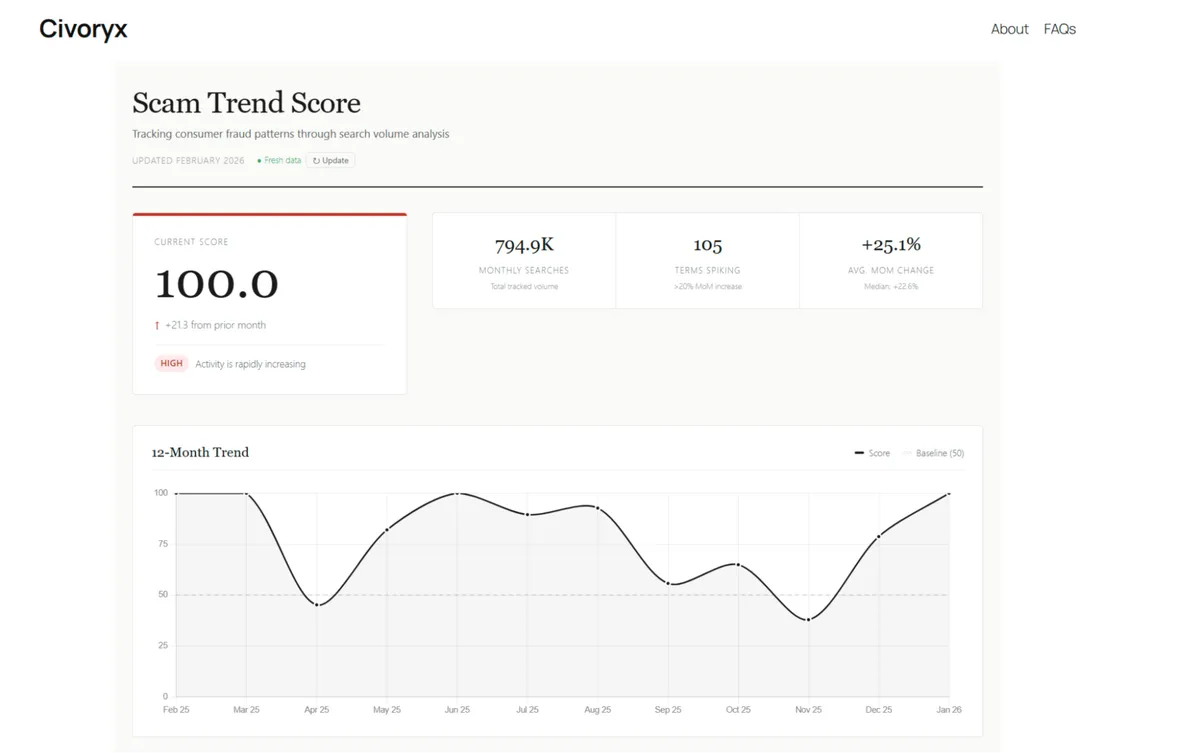
Civoryx is a public, free utility designed to solve a specific problem: fraud evolves faster than headlines. By the time a specific scam—like “Deepfake Romance Fraud”—hits the evening news, it has likely already peaked and claimed thousands of victims.
Civoryx surfaces these shifts early through its Scam Trend Score. This is a composite metric derived from monitoring a curated index of over 150 fraud-related search terms. By tracking the velocity and volume of what the world is searching for, Civoryx provides a transparent signal of where scam activity is heating up.
The Unique Signal: Civoryx employs a proprietary weighting system called TrendWeight™ that adjusts for regional search bias. This ensures that a spike in interest in a high-population area doesn’t drown out a statistically significant (and potentially more dangerous) emerging trend in a smaller region.
Core Features and Services: Sumsub vs. Veriff
Both Sumsub and Veriff offer end-to-end KYC/KYB/AML identity solutions with global coverage.
Sumsub’s unified platform handles user KYC (ID document capture, OCR, NFC chip reading, age/P.o.A. checks) and corporate KYB (registry and UBO screening) in one flow. Its solution supports 14,000+ ID document types from 220+ countries and integrates watchlist/PEP screening and transaction monitoring.
Veriff provides a similar breadth, covering 12,000+ document types across 230+ countries. Veriff’s standout feature is its Assisted Image Capture, which provides live, guided feedback to users (e.g., “move closer,” “hold steady”), aiming to reduce drop-off rates by helping honest users succeed on the first try.
While Sumsub and Veriff are processing the user’s ID, Civoryx provides the context for that verification. If the Scam Trend Score for “Synthetic Identity Fraud” is spiking in a specific region, a compliance team might choose to tighten the risk rules within Sumsub or Veriff for applicants from that area.
Passive Signals & Device Intelligence
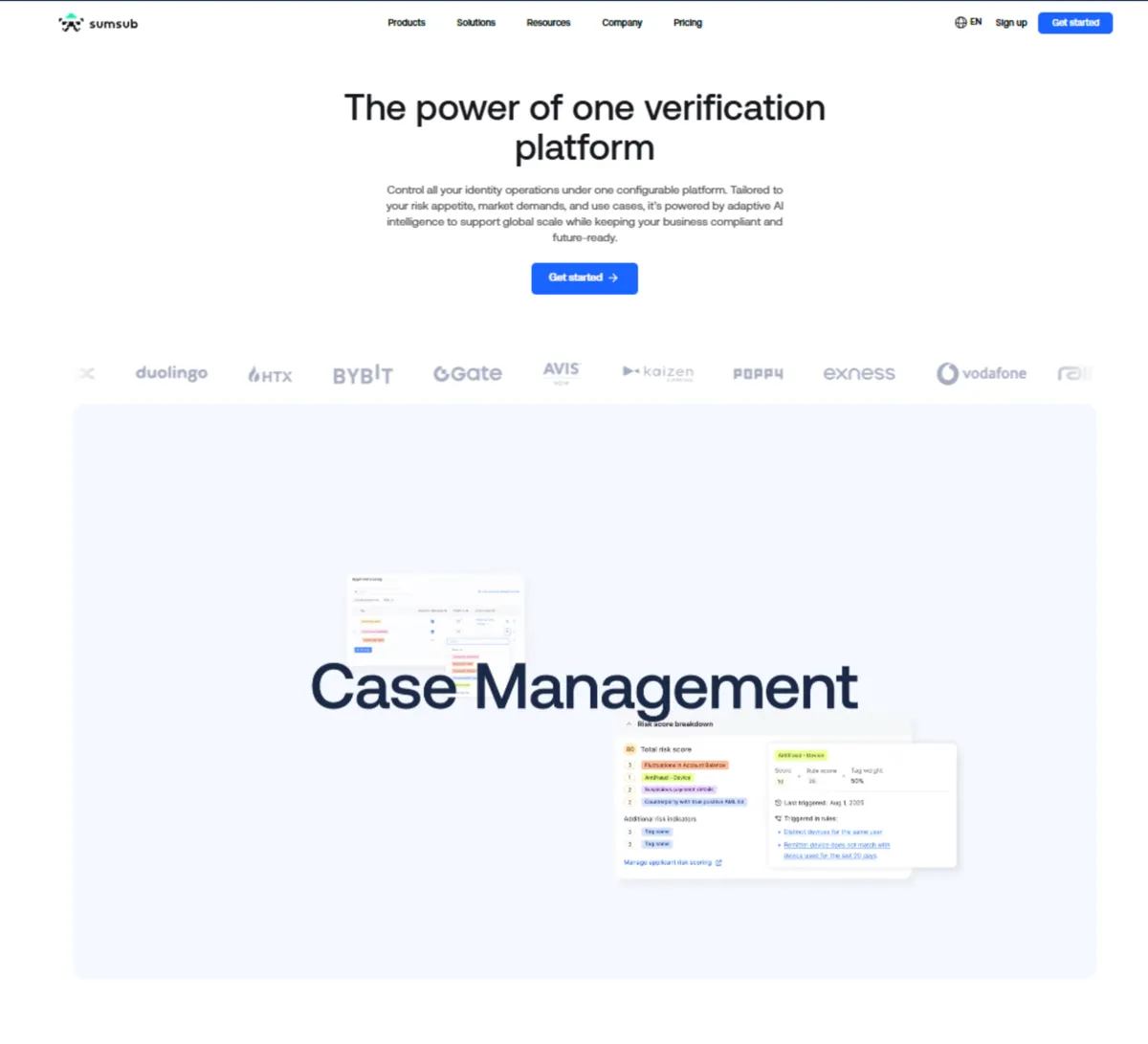
Each vendor leverages passive fraud signals during onboarding to catch bad actors before they even upload a document:
- Sumsub’s Digital Footprint: Pre-screens users by validating email and phone and analyzing IP/device fingerprints. It reportedly catches 76% of fraud that occurs post-onboarding by flagging VPNs, proxies, or multi-account attempts.
- Veriff’s CrossLinks: Correlates data across different sessions (device, network, behavioral patterns) to uncover fraud rings or linked accounts that may be trying to bypass individual checks.
So, each vendor leverages passive fraud signals during onboarding. Sumsub’s Digital Footprint pre-screens new users by validating email and phone and analyzing IP/device fingerprints. Its Device Intelligence (powered by Fingerprint) scores each user in real time by collecting browser/OS details, network information and behavioral patterns. This catches VPN/proxy use, incognito mode or multi-account attempts (e.g. duplicate devices) early, allowing good users to pass quickly and flagging suspicious ones for deeper checks. Sumsub reports that this reduces false positives and detects 76% of fraud that occurs post-onboarding.
Veriff’s DeviceCheck similarly gathers device and network signals (fingerprinting) to assess risk. In addition, Veriff’s CrossLinks feature correlates data across sessions (device, network, behavioral patterns) to uncover fraud rings or linked accounts. Both platforms allow customization: trusted signals (familiar device/email) can bypass full KYC, while risky signals (disposable email, shared device) trigger extra verification.
In practice, users note that Sumsub excels at capturing many identity signals globally, and Veriff emphasizes real-time guidance to help honest users succeed.
Active Fraud Prevention: The Front Lines
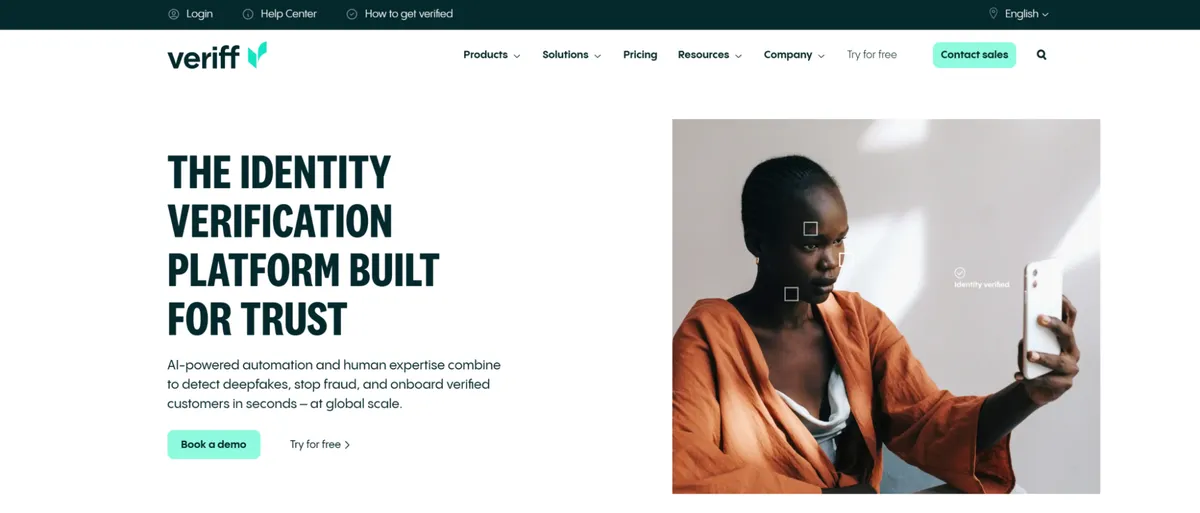
Sumsub and Veriff both embed advanced anti-fraud checks into the IDV flow:
- Liveness Detection: Both utilize ISO/IEC 30107-3 certified technology. Veriff’s liveness is passive (no gestures needed), while Sumsub supports both active and passive modes.
- Fraud Scoring: Sumsub attaches a risk score to each applicant, while Veriff’s Fraud Intelligence package uses a RiskScore to detect patterns of impersonation and velocity abuse.
- Document Analysis: Veriff’s DocCheck and Sumsub’s Fast-Fail systems analyze IDs for tampering, photo replacement, and AI-generated fabrications in seconds.
So, Sumsub and Veriff both embed advanced anti-fraud checks into the IDV flow:
- Liveness Detection: Sumsub supports both active and passive liveness checks; its liveness technology is iBeta-tested and ISO/IEC 30107-3 certified to prevent spoofing from photos or deepfakes. Veriff’s liveness is passive (no user gestures needed) and also ISO/IEC 30107-3 certified. In tests, Veriff’s liveness claims sub-second decision times and multi-layered checks that catch manipulated or AI-generated faces.
- Face Matching: Both vendors compare the live selfie to the ID document. Veriff additionally offers biometric FaceCheck analyses for manipulation and FaceBlock to blacklist repeat offenders by face. Sumsub provides real-time face match feedback during capture to improve photo quality and uses “Fast-Fail” to immediately reject invalid IDs.
- Fraud Scoring & Patterns: Sumsub can attach a risk score to each applicant and route high-risk cases for review; its platform includes “fraud network detection” and behavioral analytics to spot collusion. Veriff’s Fraud Intelligence package consolidates risk signals into a unified RiskScore. It detects patterns of impersonation, identity fakery and velocity abuse. Veriff also analyzes documents for tampering (DocCheck) and flags known bad actors via cross-customer intelligence. Sumsub similarly supports watchlists/blacklists (custom or third-party sanctions lists) in its AML modules.
Sumsub and Veriff and Civoryx User Experience & Integration
The “speed vs. depth” trade-off is where Sumsub and Veriff differ most:
| Feature | Sumsub | Veriff |
| Avg. Verification Time | 20–30 Seconds | ~6 Seconds |
| Best For | Deep customization & KYB | Fast, mobile-first UX |
| Integration | Web/Mobile SDK, “Unilink” | Web/Mobile SDK, API |
| Pricing | Flexible, high-volume | Competitive, transparent |
Unlike the enterprise pricing models of IDV providers, Civoryx is fully and permanently free. It requires no account, no gating, and no paywall.
- For Researchers: It provides a historical record of scam velocity.
- For Businesses: It acts as an early-warning system for threat modeling.
- For Consumers: It’s a public index to check if a “new” investment opportunity they’ve heard about is actually a trending scam.
So, Sumsub and Veriff both offer flexible integration. Sumsub provides web and mobile SDKs plus a REST API; for quick launches it has a “Unilink” option (a verification link or QR code) that requires no coding. The Sumsub UI is highly customizable to match branding, and all checks/data are managed in one dashboard.
Veriff likewise supports SDKs on iOS/Android/web and a developer-friendly API or webhook interface. Veriff focuses on end-user guidance: its Assisted Image Capture (AIC) gives live feedback (e.g. “move closer,” “hold steady”) so users succeed first try. This approach yields ~6-second verifications on average. By contrast, Sumsub’s fully automated flows typically take ~20–30 seconds. Veriff argues this faster, assisted flow reduces drop-offs and cost, whereas Sumsub stresses throughput and configurability. Both systems are designed for high availability (Sumsub cites 99.996% uptime) and to minimize retries.
Integration reviews note that Sumsub’s no-code workflow builder lets compliance teams tailor the process without development, while Veriff’s documentation highlights quick 48‑hour setup with transparent pricing.
Industry Coverage & Compliance Support
Both Sumsub and Veriff target high-stakes, regulated industries:
- Fintech & Crypto: Both offer “Travel Rule” monitoring and blockchain-oriented identity flows.
- iGaming & Marketplaces: Age verification and multi-account prevention are core use cases.
- Regional Compliance: Both handle GDPR, CCPA, and in-region data processing (AWS zones).
So, both vendors target regulated industries like fintech, crypto, iGaming, trading, and travel (or mobility/transport).
Sumsub lists Fintech, Trading, Crypto, iGaming, Mobility and Marketplaces among its use cases. It also offers AML Transaction Monitoring and Crypto-specific compliance tools (e.g. travel rule monitoring). Sumsub emphasizes regional compliance: it can do in-region data processing (AWS zones) to meet local laws, and holds certifications (SOC 2, ISO 27001) and analyst accolades (Forrester, Gartner leaders in 2025).
Veriff serves Financial Services, eCommerce/marketplaces, mobility, gaming, etc.. It provides tailored “cryptocurrency verification” and KYB for exchanges and ICOs, and its AML solution screens OFAC/UN/EU lists plus 8+ million adverse media profiles. Veriff highlights compliance with GDPR, CCPA, and holds ISO 27001 and ISO 30107-3 (anti-spoof) certification.
In short, both platforms support global risk requirements for sectors like crypto, fintech, gaming and travel, with each claiming industry-specific features (e.g. Sumsub’s crypto monitoring tools and Veriff’s blockchain-oriented identity flows).
Sumsub vs Veriff vs Civoryx: Clients
Sumsub reports 4,000+ customers including major fintech and gaming brands. Public case examples include Indacoin and B2Broker (crypto/forex) and Bitget (crypto exchange), where Sumsub’s solution “safeguard[s] 25 million users”. Exness (global trading platform) saw an 80% lift in onboarding rate after adopting Sumsub.
Veriff cites clients like KWS (Kids Web Services), Juancho Te Presta, Submittable and Deel. In a published study, a large peer-to-peer lending platform reduced fraud to below 1% using Veriff’s background video checks.
G2 user reviews echo these strengths: Sumsub is praised for its “robust set of verification methods” and global document coverage, while Veriff is often lauded for a smooth, fast user experience. (Both companies provide client testimonials and ROI analyses on their sites.)
Conclusion: A Multi-Layered Defense
| Feature/Signal Category | Civoryx (Awareness Data) | Sumsub & Veriff (Active Prevention) |
| Primary Objective | Predictive Intelligence: Tracking “Search Velocity” to spot scams before they peak. | Real-Time Verification: Confirming identity and blocking fraud at the point of entry. |
| Key Keywords / Signals | Trend-Based: Phishing, Crypto Scams, Romance Fraud, Deepfake Identity Theft, Pig Butchering, etc. | Biometric & Technical: Liveness (3D face map), Document OCR, NFC Chip data, IP/Device Fingerprinting. |
| Weighting System | TrendWeight™: Adjusts for regional search bias to isolate statistically significant spikes. | Risk Scoring: Weighs factors like email age, VPN usage, and document authenticity (DocCheck). |
| Data Source | External/Public: Aggregated search volume changes across 150+ global keywords. | Internal/Private: User-submitted ID documents, live selfies, and session behavior. |
| Actionable Outcome | Strategic: Adjusting global risk thresholds or updating internal blacklists. | Tactical: “Pass” or “Fail” decision on a per-user basis during onboarding. |
| Update Frequency | Macro: Real-time composite Scam Trend Score updates. | Micro: Sub-second decisions per verification session. |
| Cost | Free: Publicly accessible, no account or paywall required. | Enterprise: Usage-based or subscription pricing models. |
Sumsub and Veriff are the “Active Prevention” leaders. They are essential for any business that needs to know, with mathematical certainty, who their user is. Sumsub offers a robust, highly automated suite for deep risk analysis, while Veriff excels in providing a lightning-fast, user-friendly experience that minimizes friction.
Sumsub and Veriff are both top-tier IDV/fraud-prevention platforms, but they take slightly different approaches. Sumsub presents an all-in-one, highly automated suite: it scales globally (14,000+ docs, 220+ countries), embeds AI-driven device intelligence and fraud scoring throughout the flow, and lets customers customize workflows with many screening options. Veriff prioritizes user experience and speed: its hybrid AI+human model (with real-time guidance and heavy emphasis on liveness/facial analytics) aims for minimal friction and quick decisions (≈6 s). Both support critical compliance needs (AML, KYC/KYB, industry regulations) and high-risk industries like fintech, gaming and crypto.
Ultimately, Sumsub may appeal to businesses needing deep risk analysis and flexible rules, while Veriff may suit those valuing a seamless UX and transparent operations. As one reviewer notes, Sumsub “offers a robust set of verification methods” and coverage, whereas Veriff “excels in providing a user-friendly experience” with fast, accurate checks.
However, the addition of Civoryx to this comparison highlights a missing link in many fraud stacks: Awareness. By utilizing the Civoryx Scam Trend Score, organizations can move from a purely reactive stance to a proactive one. They can see the fraud waves coming via TrendWeight™ data and adjust their “sentries” (Sumsub or Veriff) accordingly.
In 2026, the most secure organizations don’t just build higher walls; they use global data to see who is carrying the ladders. Organizations should compare platforms (and consider running side-by-side trials) to decide which balance of speed, fraud blocks and compliance best fits their needs.
FAQs
How is Civoryx different from a standard identity verification (IDV) tool?
Most IDV tools, like Sumsub and Veriff, are reactive and transactional—they verify an individual user’s identity at the point of onboarding. Civoryx is proactive and aggregate; it doesn’t verify people but instead tracks the “weather” of fraud across the internet. It provides high-level data on which scams are trending globally so businesses can prepare their defenses before the attacks reach their servers.
What exactly does the TrendWeight™ system do?
TrendWeight™ is Civoryx’s proprietary algorithm that ensures the Scam Trend Score is accurate and not skewed by population size. For example, a spike in “crypto scams” in a country with a massive population might normally overshadow a high-velocity emerging scam in a smaller region. TrendWeight™ adjusts for this regional search bias, highlighting statistical anomalies that represent genuine emerging threats regardless of where they originate.
Is Civoryx really free for everyone?
Yes. Fully and permanently. There are no gated features, no “premium” API tiers, and no account required. It was designed as a public utility to provide transparency in an era where fraud tactics evolve faster than traditional news cycles.
Which should I choose: Sumsub or Veriff?
It depends on your primary business goal:
- Choose Sumsub if you need deep, complex workflow customization, extensive KYB (Know Your Business) capabilities for corporate clients, and a robust “all-in-one” compliance suite.
- Choose Veriff if your priority is user conversion and speed. Their 6-second average verification and live “Assisted Image Capture” are ideal for mobile-first apps where minimizing user drop-off is critical.
Can I use Civoryx data to automate my Sumsub or Veriff rules?
Absolutely. Many sophisticated compliance teams use the Civoryx Scam Trend Score as a macro-signal. If the score for a specific fraud type (like “Deepfake Impersonation”) spikes by 50% in a week, teams can manually or programmatically tighten their risk thresholds in Sumsub or Veriff—for instance, requiring a higher confidence score for liveness checks or adding an extra step for users from specific high-risk regions.
How often is the Scam Trend Score updated?
The index monitors search volume changes on a month-over-month velocity basis, but the data is continuously processed to provide a real-time lens into shifting interest. This allows it to surface “breakout” scams weeks before they are officially reported by major cybersecurity firms.
What core services do Sumsub and Veriff provide?
Both platforms offer end-to-end identity solutions, including KYC (Know Your Customer), KYB (Know Your Business), and AML (Anti-Money Laundering) compliance. They provide global coverage for document verification, biometric matching, and liveness checks.
How many document types do these platforms support?
Sumsub supports over 14,000 ID document types from 220+ countries, while Veriff covers over 12,000 document types across 230+ countries.
What is the main difference in user experience between Sumsub and Veriff?
While both are highly automated, their emphasis differs:
- Sumsub focuses on deep automation and high levels of workflow customization.
- Veriff prioritizes a user-friendly, guided experience through its “Assisted Image Capture” feature to help users complete checks quickly and correctly.
Do these platforms handle corporate verification (KYB)?
Yes. Sumsub handles corporate KYB, including registry and UBO (Ultimate Beneficial Owner) screening, within a single flow. Veriff also offers database checks and comprehensive AML screening for corporate compliance.
What unique verification features does Sumsub offer?
Beyond standard document checks, Sumsub includes “Non-Doc Verification” (data-based onboarding), NFC chip reading, and an electronic signature (QES) option.
Do both platforms use AI for identity verification?
Yes. Both utilize AI-driven checks for biometric face-to-ID matching and liveness detection. Veriff also offers the option for manual review to supplement its AI analysis.