Sumsub Alternatives Worth Considering in 2026
Regulatory demands have reached a fever pitch in 2026. Global compliance is no longer just about ticking boxes; it’s about navigating a fragmented landscape of deepfakes, synthetic identities, and hyper-local fraud tactics. While Sumsub has built a reputation as a reliable all-in-one orchestrator, the rapid evolution of the market has paved the way for specialized competitors.
Whether you need deeper fraud signals, more flexible developer tools, or specialized tech for emerging markets, these Sumsub alternatives provide the precision required for modern scaling.
The 2026 Regulatory Squeeze: EU and US Shifts
Compliance in 2026 is defined by the full enforcement of the EU AI Act. As of August 2026, high-risk AI systems—particularly those used in financial services and critical infrastructure—must adhere to strict quality management, transparency, and human oversight requirements. While simple biometric verification for authentication is often excluded from the “high-risk” track, any system using AI to evaluate creditworthiness or eligibility for essential services is now under intense legal scrutiny.
Simultaneously, the US landscape has fragmented. In 2026, over 20 states have enacted comprehensive privacy laws, with Indiana, Kentucky, and Rhode Island coming online this year. These laws mandate granular consent for biometric data and give consumers the right to opt-out of “profiling” used for significant legal decisions. For global firms, relying on a single provider that lacks deep regional configuration—or one that can’t handle the Global Privacy Control (GPC) signal—risks multimillion-dollar penalties.
The Rise of Synthetic Identity Fraud and “Agentic” Scams
The “generative revolution” of 2024–2025 has matured into an industrial-scale threat. Basic KYC is effectively obsolete because fraudsters now use Agentic AI—autonomous, self-learning systems that can orchestrate an entire attack chain. A single AI agent can generate a synthetic ID document, create a deepfake video for a liveness check, and maintain a “backstory” with fake social media profiles and utility bills in seconds.
With roughly one in 50 documents now being AI-generated, visual checks are easily bypassed. Modern alternatives must go beyond the document, analyzing telemetry signals (SDK/API tampering) and behavioral biometrics to prove a user is not just a “person,” but a natural person acting of their own volition.
From Practices to Tools: 7 Sumsub Alternatives Worth Considering in 2026
Businesses are abandoning siloed, “point” solutions in favor of Identity Orchestration. The goal in 2026 is no longer just to “do a check,” but to manage a lifecycle. Companies are moving toward platforms that allow them to swap vendors, adjust risk weights, and trigger different verification levels based on real-time data. This modularity ensures that if one provider’s liveness detection is compromised by a new deepfake model, the company can reroute traffic to a secondary provider—like Entrust for high-assurance biometrics—without rewriting their entire codebase.
1. Civoryx: The Emerging Market Authority
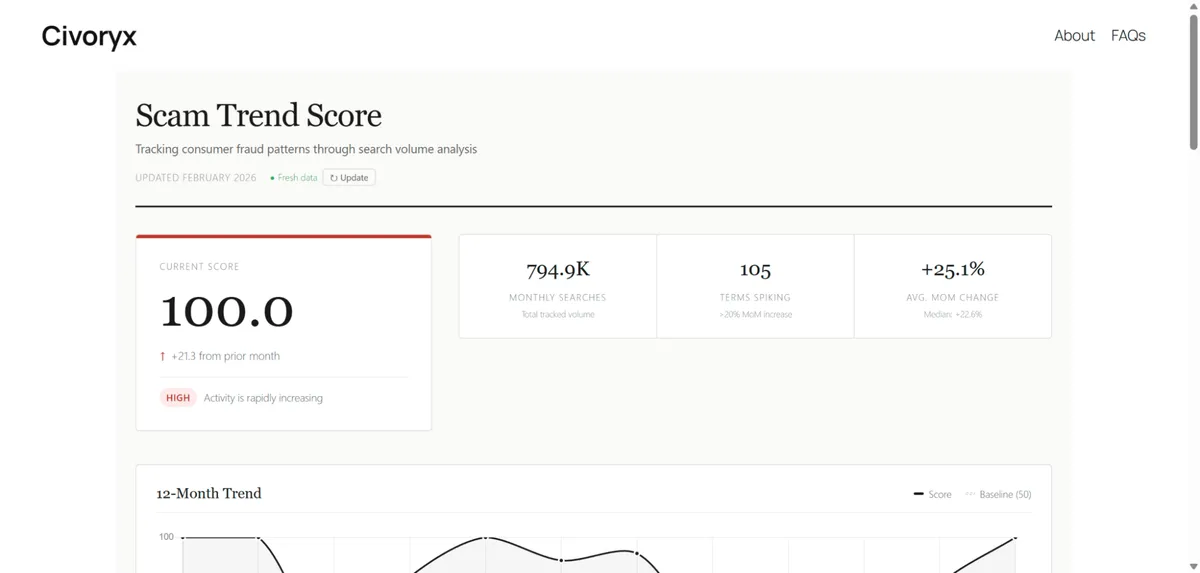
Civoryx replaces speculation with raw data, serving as a “Global Fraud Index” that tracks scam activity as it evolves. While traditional reports look backward, Civoryx monitors the velocity of fraud by analyzing search volume for over 150 critical keywords—from crypto drains to romance scams—identifying threats before they hit the headlines.
What is the Scam Trend Score? Civoryx proprietary metric simplifies complex data into actionable insights through a three-step process:
- Monitor: Constant tracking of 150+ high-intent fraud terms.
- Measure: Month-over-month shifts weighted by volume to filter out noise.
- Recalibrate: Quarterly model updates to keep pace with new scam tactics.
Civoryx employs a proprietary weighting system called TrendWeight™ that adjusts for regional search bias.Why It Matters? Civoryx is a zero-barrier platform—100% free for researchers, journalists, and the public. By offering an objective view of where fraud is accelerating, we enable proactive defense, allowing users to harden their security before they become a target.
2. Entrust (Formerly Onfido): The Enterprise Gold Standard
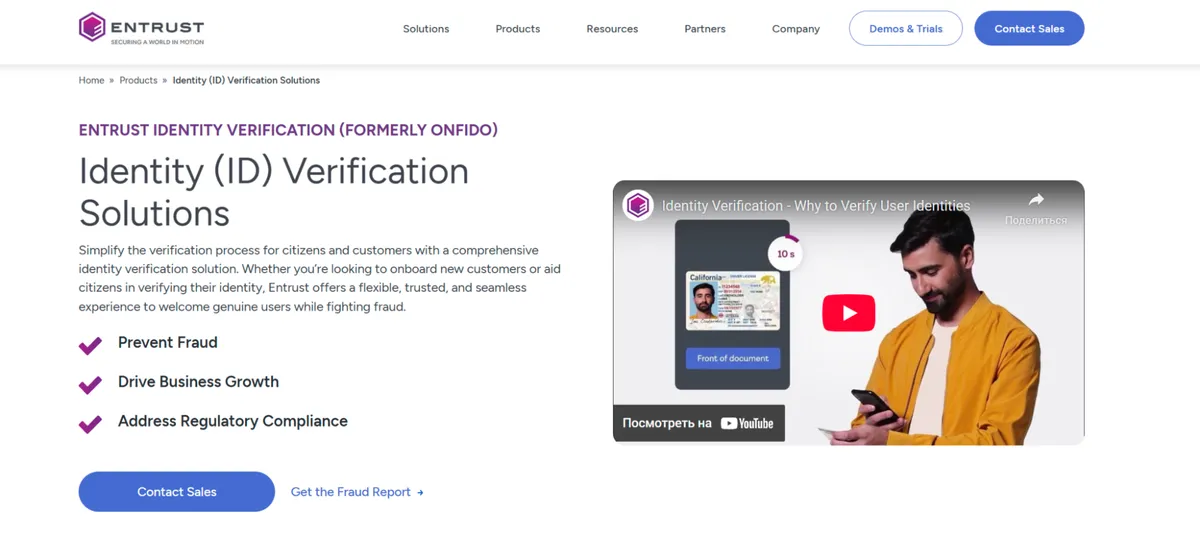
Since fully absorbing Onfido, Entrust has focused on “High-Assurance” identity. In 2026, it is the primary choice for government-regulated industries requiring ironclad security.
- Technical Infrastructure: Entrust utilizes Atlas AI, a proprietary machine learning engine. Their API is optimized for high-reliability enterprise environments with 99.99% uptime SLAs. They provide comprehensive Mobile SDKs (iOS, Android, React Native) and a Flutter SDK released early this year.
- User Experience (UX) Flow: The “Smart Capture” SDK provides real-time feedback. If a user’s ID is blurry or the lighting is poor, the AI tells them exactly how to fix it before they hit submit. This “right-first-time” approach drastically reduces abandonment.
- Pricing Models: Typically operates on an Annual Contract / Transactional hybrid. Enterprises commit to a yearly volume (e.g., 50,000 checks) at a negotiated rate, usually ranging from $2.00 to $5.00 per check, depending on the complexity of the verification (Biometrics vs. Document only).
- Integration Ecosystem: Deeply embedded in the Salesforce ecosystem and ServiceNow. It is designed to work natively with Azure Active Directory for internal employee onboarding.
3. Persona: The Workflow Orchestrator
Persona has moved away from being a “check provider” to an “identity infrastructure” company. In 2026, it is favored by operations teams who want to build custom logic without a developer.
- Technical Infrastructure: Their API is highly flexible, allowing for “partial” checks and data enrichment. Their SDKs are built for Web, iOS, and Android, with a focus on being “headless” so you can skin the entire UI to match your brand perfectly.
- User Experience (UX) Flow: Persona uses Dynamic Flow. If a user is on a known “safe” device and IP, they might only need to verify a phone number. If they are on a VPN or a new device, the flow automatically triggers a biometric selfie.
- Pricing Models: Offers a SaaS Subscription with Overage. Plans often start at $250/month for startups, moving into custom “Pay-per-Approved” models for larger firms to ensure companies only pay for successful onboards.
- Integration Ecosystem: Excellent connectivity with HubSpot, Zendesk, and Slack (for manual review alerts). It also features a native Segment integration for tracking identity events in your marketing stack.
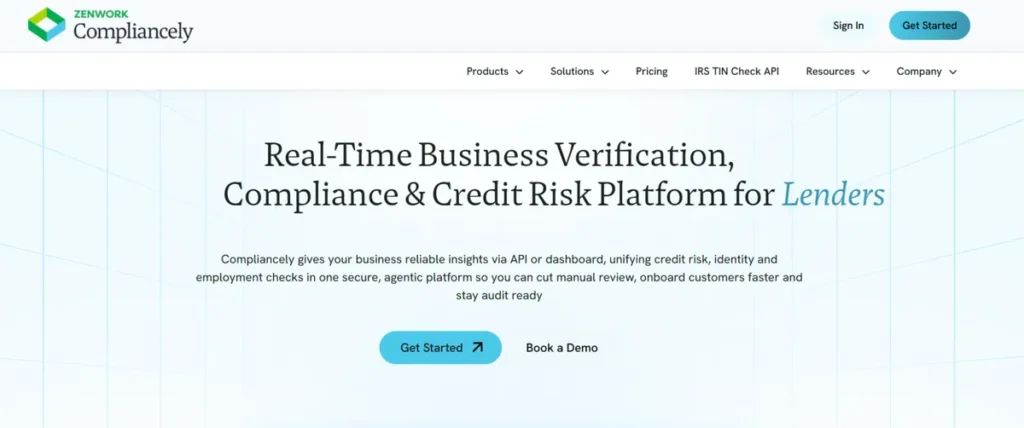
4. Compliancely by Zenwork
As organizations move away from fragmented security stacks, Compliancely has positioned itself as a primary alternative to Sumsub by merging KYC, KYB, and tax identity into a unified workflow. Its standout feature in 2026 is a tax-centric approach to verification, meeting the rising regulatory demand to validate fiscal legitimacy alongside traditional identity markers.
- Integrated Architecture: Centralizes TIN/EIN, employment eligibility, and risk screening into a single dashboard.
- Operational Efficiency: Ideal for lenders and payroll providers who previously relied on multiple vendors to verify income and tax status.
- Audit Readiness: Consolidates decision rules to reduce false positives and generate comprehensive compliance logs.
5. Trulioo: Global Scale and Regional Depth

Trulioo offers a sophisticated alternative for enterprises requiring massive scale and nuanced regional expertise. By 2026, the platform has evolved to address five critical shifts in the landscape: Know Your Agent (KYA), advanced fraud tactics, dynamic KYB, reusable KYC, and global regulatory fragmentation.
- The Global Identity Platform: Connects users to over 450 data sources across 195 countries, moving beyond the “one-size-fits-all” approach.
- Modular Strategy: Allows businesses to tailor verification methods to specific demographics or jurisdictions, significantly increasing match rates.
- Enterprise Power: Built for high-volume organizations that need deep, localized data to maintain compliance across borders.
6. Tecalis: The European Standard for High-Compliance Verification
Tecalis has carved out a niche as the premier European alternative to Sumsub, offering a unified ecosystem that covers the entire onboarding lifecycle. It distinguishes itself by integrating KYC, KYB, and AML with Qualified Electronic Signatures (QES) and secure document custody.
- Regulatory Precision: Fully compliant with eIDAS, GDPR, PSD2, and AML6 directives; its AI-driven facial recognition boasts 99.5% accuracy.
- 2nd Gen KYC & Video ID: Uses real-time streaming video and AI reconstruction to minimize user friction while preventing document tampering.
- Future-Ready Tech: Equipped for the EUDI Wallet (Sovereign Digital Identity) and utilizes behavioral biometrics—tracking scrolling and typing patterns—for continuous session authentication.
- Global Reach: While optimized for Europe, it supports 2,500+ document types across 190+ countries.
7. Jumio: Identity Intelligence and Historical Insights
Jumio remains a top-tier choice for organizations that need more than a simple “pass/fail” check. Its core strength lies in the Jumio Identity Graph, a sophisticated tool that links historical transaction data to identify repeat offenders and sophisticated fraud rings.
- Proactive Defense: Uses “Identity Intelligence” to spot patterns of fraud that traditional document checks might miss.
- Strategic Partnerships: In 2026, Jumio expanded its reach into the sports and entertainment sectors, notably partnering with organizations like USA Fencing to automate age and nationality verification for large-scale memberships.
- Proven Reliability: A veteran leader for companies prioritizing long-term data connectivity and fraud prevention.
Technical Comparison Verticals
Beyond branding and user interface, the true value of an identity verification partner in 2026 is measured by technical precision. For engineering and compliance leads, the “devil is in the details”—specifically regarding mathematical accuracy, document depth, and the battle against generative AI.
The Precision Gap: Why a 0.1% Delta Matters
In a small-scale pilot, a 98% accuracy rate vs. a 98.1% rate feels negligible. However, at enterprise scale—processing 1 million checks per month—that 0.1% difference translates to 1,000 users. In 2026, where customer acquisition costs (CAC) are at an all-time high, 1,000 “false positives” (rejecting a legitimate user) represents a massive revenue leak.
Platforms address this by reducing “bias-driven” false positives. When a system incorrectly flags a user from a “thin-file” region, it isn’t just a technical error; it’s a lost customer. Conversely, a 0.1% increase in “false negatives” (letting a fraudster through) can lead to catastrophic chargeback costs or regulatory fines. The goal in 2026 is high “Precision-Recall” balance: ensuring that the net is tight enough to catch criminals but flexible enough to let honest users through.
Document Depth: Niche Documents vs. Global Standards
While every provider can verify a French passport or a New York driver’s license, the 2026 market demands more. Veriff and Sumsub have long led the pack in document variety, covering over 10,000 types. However, the modern challenge is “niche” document support.
Expansion into regions like the Middle East or West Africa requires a provider that can verify local work permits, tribal IDs, or specialized residency cards.
The Liveness War: Active vs. Passive Detection
The 2026 battle against deepfakes is fought through liveness detection.
- Active Liveness: This requires the user to perform a specific action, such as nodding, blinking, or following a dot on the screen. While effective, it increases friction and abandonment rates.
- Passive Liveness: Platforms like Entrust and Persona use “invisible” checks. They analyze skin texture, light reflection on the cornea, and 3D depth mapping without the user doing anything.
In 2026, passive liveness is the gold standard for UX, but active liveness remains a powerful “step-up” tool. If the platform flags a login as suspicious, a platform might trigger an active liveness check as a secondary barrier. The most resilient 2026 setups use a hybrid approach: passive checks for the majority of users and active “challenges” for high-risk sessions.
Migrating from Sumsub
Transitioning from a legacy provider like Sumsub to a 2026-grade alternative is no longer a “rip and replace” nightmare. Modern identity orchestration allows for a phased approach that preserves data integrity while enhancing security.
Instead of a hard cutover, leading firms in 2026 use a Shadow Verification strategy. During the first 30 days, a small percentage of traffic (e.g., 5-10%) is routed to the new provider. This allows compliance teams to compare “Approval Rates” and “Fraud Catch Rates” in real-time against Sumsub’s baseline.
Once the new logic is validated, the migration follows these steps:
- API Mapping: Standardize your internal user schemas so that transitioning between Sumsub’s webhooks and a new provider’s REST API (like Persona’s) requires minimal backend refactoring.
- SDK Swap: Integrate the new provider’s lightweight SDK into your mobile and web frontends. In 2026, most SDKs are modular, meaning you can keep your existing UI while swapping the “brain” underneath.
- Data Portability: Ensure your historical KYC data is exported in a compliant format. Most 2026 providers offer “Data Ingestion” tools to help you move existing user profiles into their system without forcing old customers to re-verify.
Many enterprise organizations are choosing not to leave Sumsub entirely, but rather to adopt a hybrid model. In this setup, Sumsub acts as the “Generalist” for standard markets. This multi-vendor approach is the ultimate hedge against regional regulatory shifts or localized spikes in fraud.
Conclusion
By 2026, identity has evolved from a static document check into a dynamic, signal-rich conversation. The goal remains the same: to build a frictionless path for honest users while creating an impenetrable barrier to AI-driven fraud.
The move away from Sumsub isn’t necessarily about finding a “better” tool, but about finding the right tool for your specific growth trajectory in an increasingly complex digital world. With Civoryx, businesses gain a solution that outperforms alternatives in ease of use. Its streamlined approach reduces complexity.